
UCLA's NIL in 2026: Inside the Bruins' New Financial Model
UCLA's 2026 NIL and revenue-sharing strategy explained, with football spending estimates and recruiting analysis.

No school walked into the revenue-sharing era with more built-in advantages than UCLA. The Bruins play in the second-biggest media market in the country and drive a few minutes in any direction, and you'll hit Hollywood studios, Fortune 500 offices, venture capital firms, talent agencies, apparel brands, and pro sports franchises. Throw in one of the largest clusters of social media influencers anywhere on Earth, and you'd think UCLA should be a Big Ten NIL powerhouse without even trying.
Reality’s messier than that. Oregon has Phil Knight's checkbook, Ohio State has a donor base most schools would kill for, and Texas has oil money behind its collective. UCLA doesn't have any of that. Instead, it's carrying years of athletic department deficits, real debt, and an annual "Calimony" payment to Berkeley, all while trying to stay competitive. Even with those constraints, Athletic Director Martin Jarmond has committed publicly to paying out the maximum amount allowed under the House settlement.
That tension (big market, tight budget) is what makes UCLA one of the more interesting financial case studies in college sports right now.
UCLA Is Going All in on Revenue Sharing
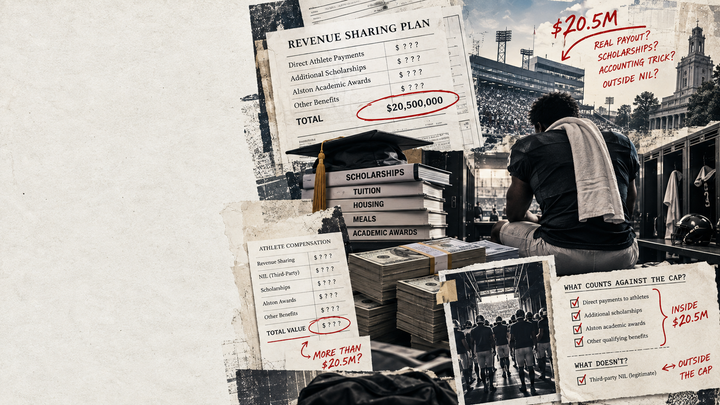
Jarmond didn't leave much room for doubt once the House settlement got its final approval. Starting in year one, UCLA committed to distributing the full allowable amount, somewhere around $20.5 million, with increases built in as the settlement formula ramps up over time. The school has also added analytics staff, beefed up its recruiting operation, and invested in roster-management tools to get ready for how the new system works.
Like almost every Big Ten school, football is getting the lion's share of that money. Here's the estimated breakdown:
- Football: $13.5–15.0 million
- Men's Basketball: $2.5–3.0 million
- Women's Basketball: $900,000–1.2 million
- Olympic Sports: whatever's left over
UCLA hasn't released exact figures, but this split lines up with what most Power Four programs are expected to do.
Estimated 2026 UCLA Athlete Compensation
|
Sport |
Revenue Sharing |
Estimated NIL |
Estimated Total |
|
Football |
$13.5–15.0M |
$10.0–13.0M |
$23.5–28.0M |
|
Men's Basketball |
$2.5–3.0M |
$3.5–5.0M |
$6.0–8.0M |
|
Women's Basketball |
$0.9–1.2M |
$1.0–2.0M |
$1.9–3.2M |
|
Baseball |
$300–600K |
$400–900K |
$700K–1.5M |
|
Olympic Sports |
$1.0–1.5M |
$2.5–4.0M |
$3.5–5.5M |
LA Gives UCLA an NIL Economy Almost Nobody Else Has
Most college programs lean hard on donor-funded collectives to pay their athletes: that's basically their entire model. UCLA has something extra: an actual commercial marketplace sitting in its backyard. Los Angeles is packed with Fortune 500 headquarters, entertainment companies, apparel brands, sports agencies, tech firms, media outlets, influencer marketing shops, and professional franchises, which gives UCLA athletes a shot at real endorsement deals that don't depend on some booster writing a check.
That's a bigger deal than it might sound. Revenue sharing has a ceiling; there's a hard cap on what schools can pay out, but commercial NIL doesn't work that way. If UCLA athletes can consistently land real endorsement income, the Bruins end up offering something schools stuck relying only on collective money simply can't match. That might turn out to be UCLA's biggest edge over the next ten years.
Champion of Westwood Sharpened Its Focus
UCLA reorganized its collective before revenue sharing even kicked in, seeing where things were headed. Champion of Westwood now sits as the umbrella group, with separate funding tracks for football, men's basketball, women's basketball, and Olympic sports. The idea was to match fundraising to actual roster needs and give donors a clearer sense of where their money's going.
That kind of specialization isn't unique to UCLA. Collectives everywhere are shifting from general fundraising outfits into targeted recruiting tools built around specific sports.
The Real Problem Isn't NIL, It's the Budget
UCLA can recruit off the strength of Los Angeles all day long, but it still must answer to its balance sheet. The athletic department has posted operating deficits in recent years and leans on significant help from the university just to stay afloat, on top of an annual payment owed to UC Berkeley under the UC Regents' "Calimony" deal.
None of this means UCLA can't compete. It just means every dollar spent must fit inside a tighter box than most fans probably assume, and schools with richer donor networks can throw more money around when transfer portal bidding wars break out. UCLA doesn't have that luxury: it must pick its spots.
Football Is Basically the Whole Plan
UCLA's financial future comes down to one thing: football. A winning team drives ticket sales, fills up the Rose Bowl, pulls in more donor money, boosts sponsorships, raises the program's media profile, strengthens recruiting, and opens more commercial NIL deals. A mediocre team chokes off all of that at once.
It's a loop that feeds itself. Winning football brings in money; that money helps build better football, and revenue sharing just speeds up whichever direction the cycle's already heading.
Basketball Might Actually Benefit More
Basketball recruits may find UCLA even more appealing than football recruits do. Basketball players, unlike football players, tend to have stronger personal brands and greater individual visibility, and playing in LA puts them close to entertainment media, pro-athlete circles, national ad campaigns, content creation, the NBA, and apparel companies. For a top basketball prospect, that kind of exposure can matter more than a slightly bigger collective check somewhere else.
How UCLA Stacks Up in the Big Ten
Ohio State has deeper donor pockets, Oregon has backing nobody else can touch, Michigan pairs national brand recognition with a wealthy alumni base, Penn State has one of the biggest fan bases in the country, and Washington taps into Seattle's corporate scene. UCLA doesn't really compete on that list: it's playing a different game entirely. Its edge isn't money; it's location, and only one other Big Ten school has Los Angeles or ever will.
Bottom Line
Revenue sharing narrows the financial gap between programs, while commercial NIL opens a new one. That difference could shape where UCLA ends up.
If the Bruins try to simply outspend Ohio State, Oregon, or Michigan, they'll probably lose that fight. But if they lean into what makes them different: real brand-building opportunities, national media exposure, and genuine commercial partnerships, they could end up with one of the most sustainable recruiting models in the country.
Los Angeles is still one of the most valuable markets on the planet, and finding opportunities isn't the hard part. Turning one of the world's most recognizable cities into wins on Saturdays — that's the actual challenge.
Comments ()