
USC NIL in 2026: Revenue Sharing and a $40M Roster
Inside USC’s 2026 NIL operation, including revenue sharing, House of Victory, a $9M recruiting class and a football roster nearing $40M.

USC never had trouble finding rich alumni, a famous football brand, or a talent pipeline full of blue-chip recruits. What it lacked in the early NIL years was a system to turn all that into a roster that could actually compete every single season.
This article relates to a News Expeditions hub article on Big Ten NIL and revenue-sharing distributions and is part of a network of pieces that discuss each Big Ten team.
That gap is closing fast. USC is now paying into revenue sharing at the maximum allowed level, its collective has grown, and the Trojans are fielding one of the most expensive rosters in the country. A CBS Sports survey from August 2026 put USC's total roster spending in the high-$30 million range, and some Big Ten insiders think it's already crossed $40 million.
The recruiting class tells the same story. Sources told ESPN that USC's 2026 high school class came with north of $9 million in NIL money attached, much of it tied to front-loaded contracts that helped power a surge of 21 commitments between February and May of 2025. That spending helped the Trojans land the nation's No. 1 class and reclaim their old recruiting turf in Southern California.
This isn't just a bigger checkbook. USC has built a system where revenue sharing, collective fundraising, outside NIL deals, and roster management all point in the same direction. Whether that translates into a Big Ten title still comes down to coaching and development. But the old excuse that USC couldn't get organized enough to compete financially no longer holds up.
Two Tracks of Payment
The House settlement split athlete pay into two lanes. The first is direct payment from the school. Since July 2025, schools have been allowed to pay athletes straight from an athletic department pool, capped at roughly $20.5 million for 2025-26. That number climbs to about $21.3 million for 2026-27. It's a department-wide cap, not something split out by sport.
The second lane is third-party NIL. Athletes can still sign endorsement deals, do appearances, license their name and image, and get paid for social media work. None of that counts against the school's cap. Any deal worth $600 or more must be reported through NIL Go and reviewed to ensure it's a real business arrangement paying a fair market rate.
USC committed early to spending the full amount allowed. Back in January 2025, athletic director Jennifer Cohen said USC planned to invest the entire $20.5 million across its sports programs that year, and she called football the department's financial engine, the one that needed the biggest piece of that pie.
USC hasn't released actual contracts or a sport-by-sport breakdown. So, the best estimate uses the 75-15-5-5 split that's become common across college athletics: 75 percent to football, 15 percent to men's basketball, 5 percent to women's basketball, and 5 percent spread across everything else. CBS Sports found this was the most common formula among major programs, though it technically comes from how the House settlement divided back damages, not a rule for future payments. Every school can divide its money however it wants, and USC hasn't confirmed it's following this exact split. It's still the most reasonable starting point available.
Adding Up USC's Total Spending
Run that formula against a $21.3 million pool, and football gets roughly $16 million, men's basketball about $3.2 million, women's basketball around $1.1 million, and the rest of the department shares about $1.1 million.
That's only the floor. House of Victory, individual endorsement deals, and other outside contracts add millions more.
Here's a rough picture, built from USC's own commitments, national spending patterns, recent football reporting, and the current basketball market:
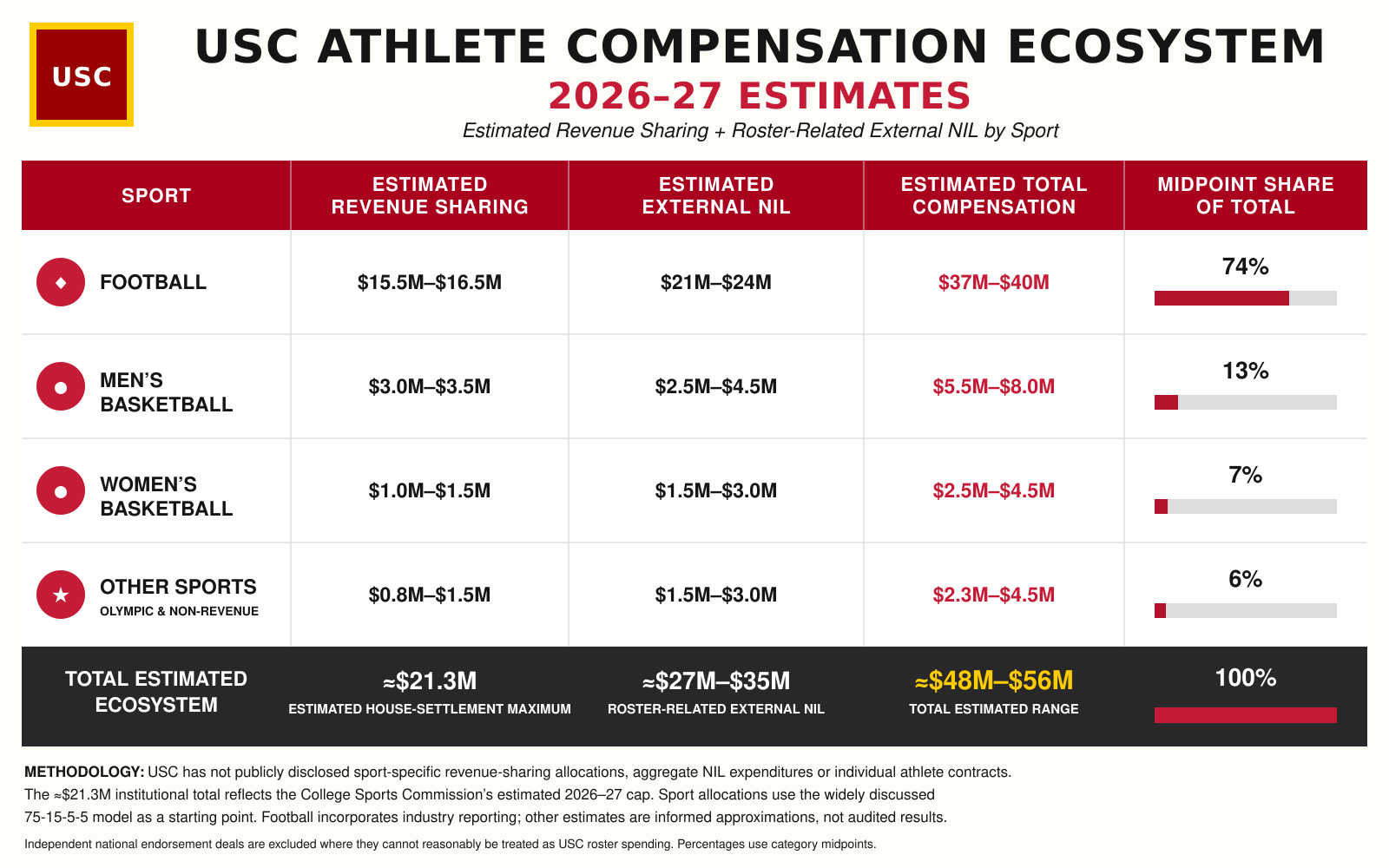
These aren't leaked payrolls. They're educated estimates. The football numbers rest on solid reporting; basketball and the smaller sports are shakier guesses.
One thing the table leaves out: purely independent endorsements, where a national brand pays a USC athlete for their personal fame rather than anything tied to USC's recruiting or retention effort. Add those in and the total balloons, but then you're measuring what USC athletes earn overall, not what the athletic department is actually spending to build its rosters.
Football's Price Tag: $37 to $40 Million
Football is the easiest number to pin down because multiple outlets have dug into it separately.
At 75 percent of the pool, the team gets about $16 million from USC's institutional money. That lines up with what Cohen has said publicly: football needs the department's biggest investment.
The NIL Standard, a player-valuation site, estimated USC's 2026 roster at $34.34 million across 83 players. Quarterback Jayden Maiava topped the list at an estimated $2.5 million, with seven-figure values also going to running back Waymond Jordan, tackles Elijah Paige and Justin Tauanuu, edge rusher Braylan Shelby, and defensive tackle Alex VanSumeren. The site is clear these are market-value estimates, not verified contracts.
CBS Sports took a different approach, surveying more than 50 coaches, agents, general managers, and front-office staff for its August 2026 report, and landed higher: high-$30 millions, possibly touching $40 million. Its sources pointed to the freshman class as the driver, and named Maiava as probably USC's highest-paid player, though they described his deal as team-friendly. USC also spent money on the portal, bringing in receiver Terrell Anderson from NC State and cornerback Jontez Williams from Iowa State.
Neither number is an audited payroll, but they don't really contradict each other. One's a valuation model; the other's built from industry chatter. Together they point to a range: USC's 2026 football roster probably costs $37 to $40 million, and the more recent reporting leans toward the higher end.
If $16 million comes from the university's own pool, that leaves $21 to $24 million coming from House of Victory and other outside deals. That means roughly 40 percent of the football budget sits inside the salary cap, and 60 percent lives outside it.
Paying for the Trenches, Not Just the Skill Positions
What USC buys matters as much as how much it spends.
Early in Lincoln Riley's tenure, USC had plenty of firepower at quarterback and receiver but not nearly enough depth up front to beat the best teams on the schedule. Moving to the Big Ten made that weakness impossible to hide.
This year's roster reflects a course correction. USC's freshman class brought in premium linemen, including tackle Keenyi Pepe, edge rusher Luke Wafle, and defensive tackle Jaimeon Winfield. Reporting has noted that Pepe, Wafle, and tight end Mark Bowman already worked into the two-deep during spring practice.
USC is still paying top dollar for quarterbacks and receivers. But it's no longer treating the offensive and defensive lines as an afterthought to fix later.
The $9 Million Class
USC's biggest single investment went toward high school recruiting. ESPN's sources put the cost of the 2026 class above $9 million, much of it in front-loaded contracts. That spending bought USC the No. 1 class in the country according to the 247Sports Composite, its first top class in years. The haul included dozens of signees, multiple five-stars, and a heavy concentration of Southern California talent.
Keeping that talent local mattered strategically. USC had watched Alabama, Georgia, Ohio State, and Oregon poach elite players out of its own backyard for years. This class wasn't just about adding talent. It was an attempt to take back control of Southern California recruiting.
That makes this spending different from renting a transfer for one season. If USC develops and keeps these players, it could mean several years of production and less dependence on the transfer portal down the road. The risk is real, since high schoolers are projections and some won't pan out. USC bet on the long game anyway.
Chad Bowden Brought Structure
None of this money would matter much without someone to organize it. USC hired Chad Bowden away from Notre Dame in January 2025, making him the program's first formal general manager. He's now central to recruiting, evaluation, and roster building. He told the Los Angeles Times in March 2025 that he wanted USC to be the sport's most aggressive program.
The whole operation looks more like a pro sports front office than old-school college recruiting: coaches flag needs, personnel staff evaluate talent, and the business side figures out the price.
House of Victory Still Matters
Direct payments from the school didn't make the collective obsolete. It just changed its job.
House of Victory calls itself USC's official athlete-marketing collective, connecting players with brands, even though it remains legally separate from the university. It operates through two arms: a nonprofit business entity that handles NIL deals and a foundation that runs charitable projects, a structure On3 detailed in 2023.
The group expanded its staff in 2024 and exceeded its fundraising goals, more than doubling its total from the year before. Cohen has said USC's work with House of Victory and other partners tripled the amount of money available for athletes' NIL, though the school hasn't shared the actual dollar figures behind that claim.
That closeness between USC and its collective is a real advantage, but it comes with compliance risk. Deals involving people tied to the university get extra scrutiny to ensure they reflect genuine business activity and fair market pay, not disguised recruiting inducements. Los Angeles gives USC a real shot at making those deals legitimate.
Basketball and the Rest of the Department
Men's basketball likely sits in the $5.5 to $8 million range once outside NIL gets added to the roughly $3.2 million institutional share. Coach Eric Musselman has acknowledged that he can't spread money evenly across 15 roster spots, so USC's basketball payroll is likely concentrated on a handful of top players rather than distributed evenly.
Women's basketball is trickier to estimate because of JuJu Watkins. SponsorUnited's data showed Watkins led all women's college athletes with 20 endorsement deals in the year ending in early 2025, including Nike, Fanatics, and Taco Bell, and much of that money comes from her personal brand rather than USC's roster budget. Stripping that out, USC's women's program likely spends $2.5 to $4.5 million between institutional money and roster-connected NIL.
The remaining 20-plus sports split roughly $1.1 million in institutional money, which comes out to just $50,000 to $60,000 per program on average, though the real split is almost certainly uneven. Outside, NIL becomes especially important here, and USC's new Nike apparel and NIL partnership, announced in mid-2026, should help fill that gap.
The Real Cost
USC is a private school, so it doesn't have to release detailed financial reports the way public Big Ten schools do. That makes it impossible to fully verify these numbers from the outside.
What is verifiable: in July 2025, USC Athletics cut twelve positions, six of them occupied, while preparing to fund revenue sharing. The Los Angeles Times tied those cuts directly to the financial pressure of the new payment model. Revenue sharing isn't free money added to the existing budget. It competes with staff salaries, travel, facilities, coaching pay, and everything else the department funds.
Where USC Stands in the Big Ten
USC belongs in the conference's top financial tier, but it's not the only one there. Oregon has Phil Knight and one of the country's most aggressive donor networks. Ohio State pairs huge athletic revenue with a strong collective. Michigan and Penn State lean on deep alumni bases, and Nebraska has shown it can rally donors around football too.
USC's edge is different: a national brand, the Los Angeles commercial market, and access to one of the country's deepest recruiting regions.
Bottom Line
USC's football roster probably costs between $37 million and $40 million this season, and the program's total athlete compensation across all sports likely runs $48 to $56 million a year. None of these figures are confirmed payrolls, but the scale is hard to miss.
Money alone won't win USC a championship. It can't prevent injuries, speed up development, or guarantee chemistry. But the financial excuse that used to follow this program around is gone. For the first time in the NIL era, the question isn't whether USC is willing to spend. It's whether Lincoln Riley can turn one of the most expensive, professionally run rosters in the country into something that wins in January.
Comments ()