
Big Ten Transfer Portal Strategies: Five Years of Data Reveal What Actually Wins
Five years of Big Ten transfer portal data reveal whether more transfers actually lead to more wins.
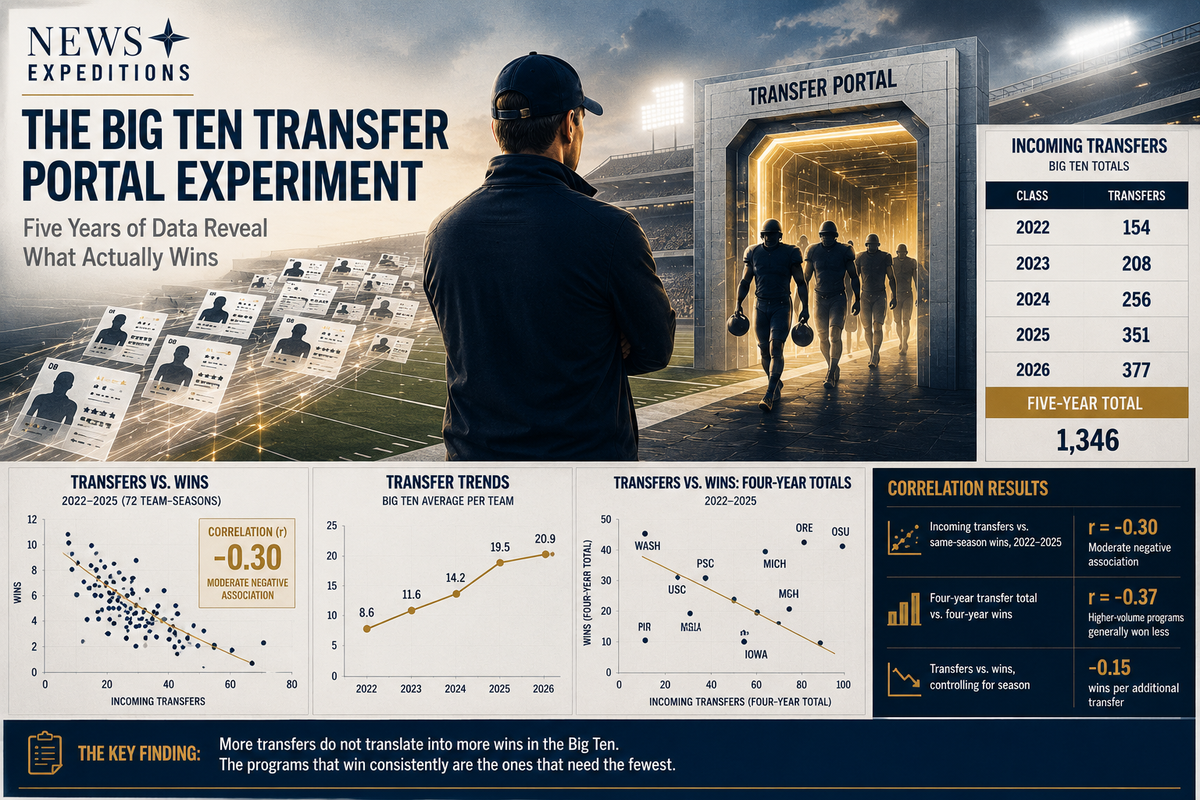
The transfer portal has grown into one of college football's main tools for building a roster, not just fixing one. Back in 2022, the current 18 Big Ten members brought in a combined 154 transfers. By 2026, that number had jumped to 377, an increase of roughly 145 percent in just four years.
The average Big Ten program went from adding 8.6 transfers in 2022 to nearly 21 in 2026. That's a massive shift in how rosters get built. So here's the obvious question: did the teams bringing in the most transfers also win the most games?
Not really. The data points the other way.
Looking at 72 team-seasons from 2022 through 2025, the correlation between transfer volume and wins came out to about –0.30. Teams that brought in more transfers tended to win fewer games, on average.
That doesn't mean transfers cause losing seasons. What it really shows is how the portal is used in practice: the teams making the most transfers are usually the ones with the most roster problems to fix in the first place.
Five Years of Incoming Transfers
Here's the breakdown of incoming transfer commitments for every current Big Ten program, from the 2022 class through 2026, based on totals reported by 247Sports. The 2022–2025 numbers can be compared against completed seasons. The 2026 class shows where each program is headed, but it can't be judged against wins yet since that season hasn't been played.
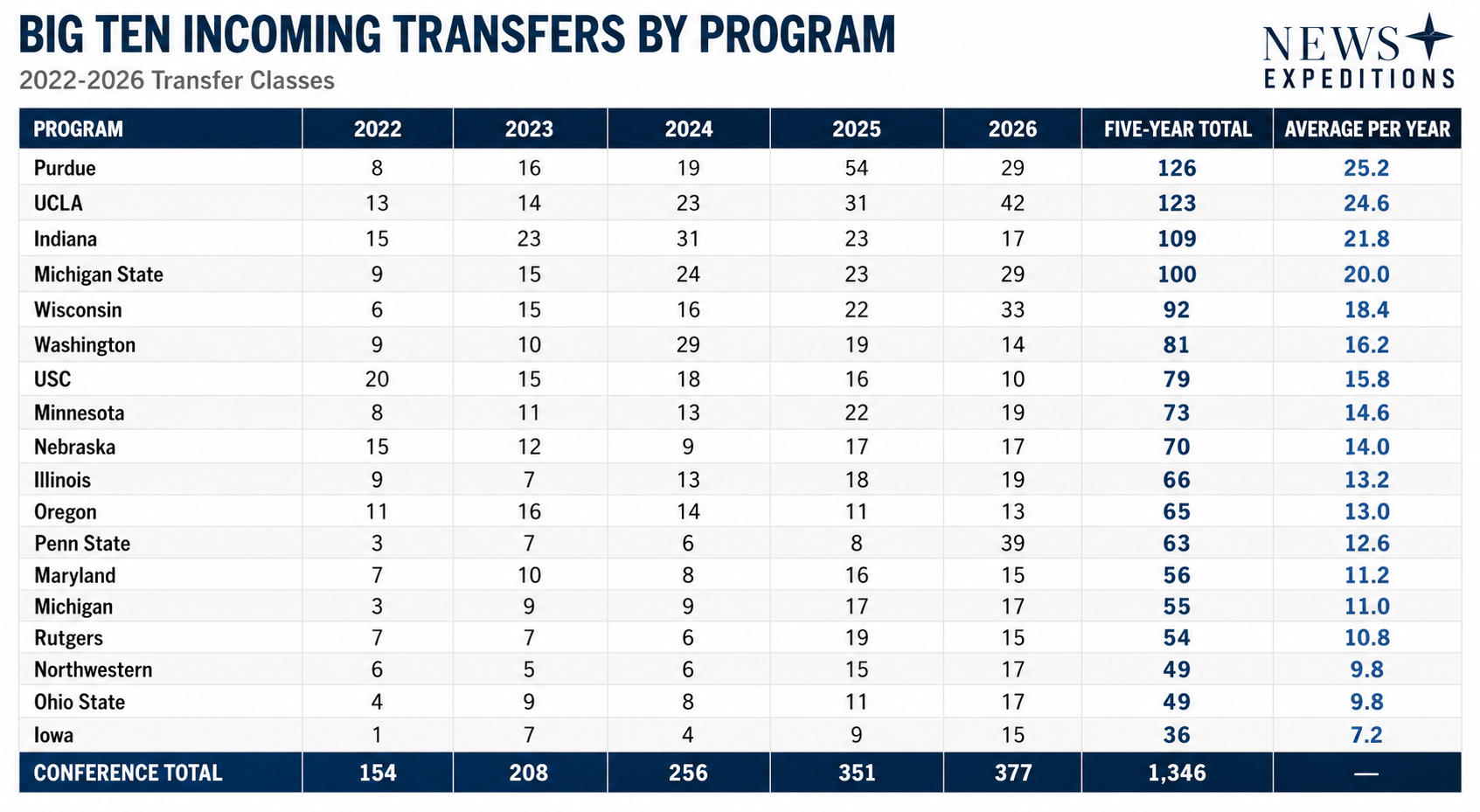
Look at the top of that table. Purdue, UCLA, Indiana, Michigan State and Wisconsin used the portal the most. Four of those five spent much of this stretch dealing with coaching changes, bad seasons, players leaving in droves, or constant roster turnover.
Indiana is the big exception here. The rest of that group mostly proves that huge transfer classes tend to go hand in hand with instability, not sustained winning.
Do Incoming Transfers Actually Turn into Wins?
To dig into this, the 2022–2025 transfer totals were matched up against each program's win total for that same season. That gives us 72 data points: 18 current Big Ten programs across four completed seasons.
The 2025 Big Ten standings stretched from Indiana at 16–0 all the way down to Purdue at 2–10, and several of the biggest portal users landed near the bottom. Records from 2022 through 2024 were based on conference and season standings.
Correlation Results
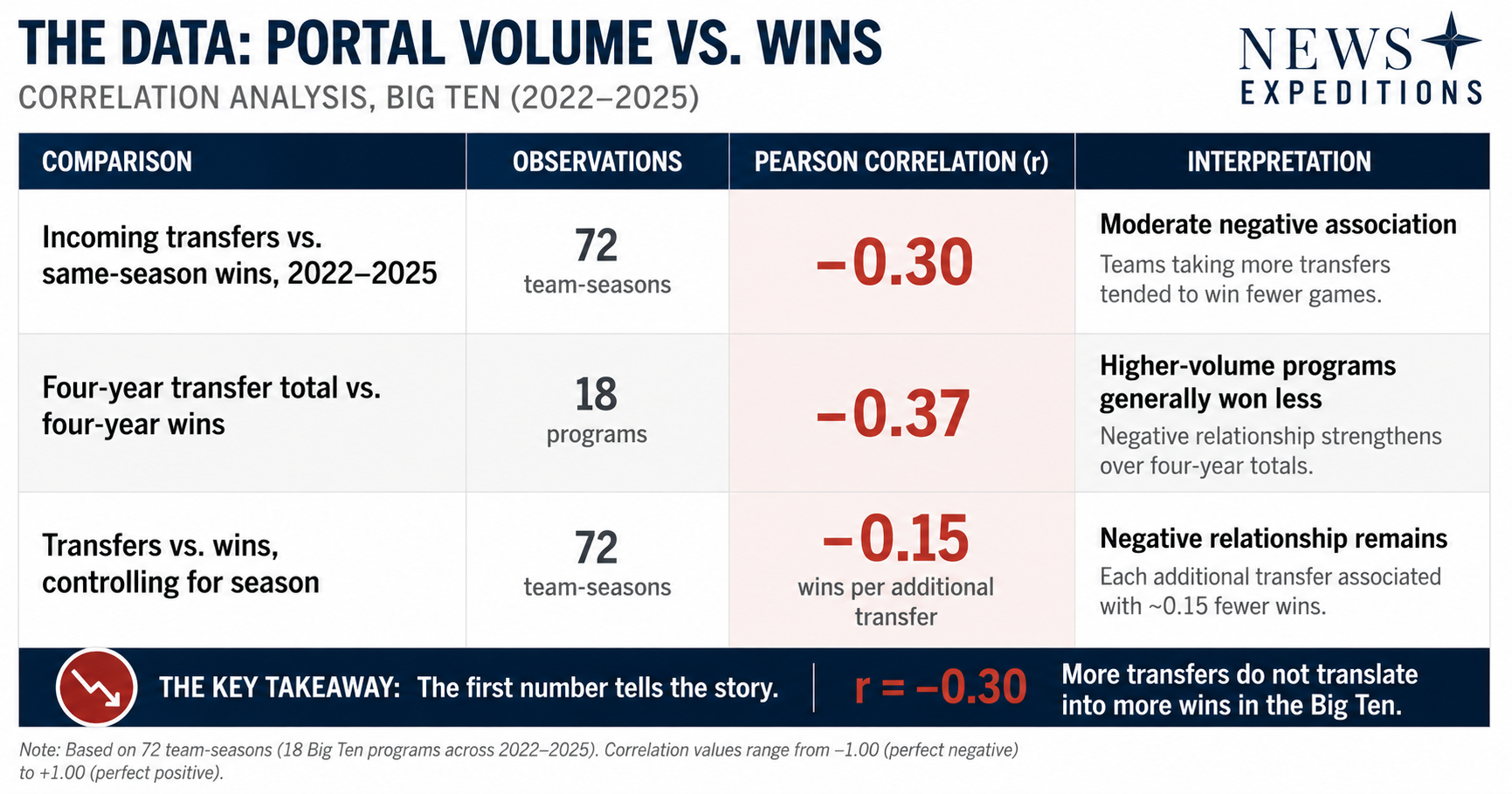
That first number tells the story: r = –0.30.
A correlation of –1.00 would mean a perfect inverse relationship, and zero would mean there's no linear relationship at all. A result of –0.30 isn't overwhelming, but it's strong enough to push back against the idea that signing more transfers usually leads to more wins.
This pattern also held up statistically, with a p-value around 0.01. In plain terms, it's unlikely this negative trend is just random noise in the data.
A simple regression that accounts for the fact that portal classes kept growing over time found a similar result. Each additional transfer was tied to about 0.15 fewer wins, holding the season constant. So, a ten-player jump in transfer volume lined up with roughly 1.5 fewer wins.
That doesn't mean adding ten transfers will cost you a game and a half. This is a descriptive pattern, not a cause-and-effect one. It means the programs bringing in ten more transfers were usually already dealing with a weak roster, coaching turmoil, or players walking out the door.
The Four-Year Comparison Makes the Pattern Clearer
Since one wild season can throw off a single-year comparison, it helps to look at the 2022–2025 totals together.
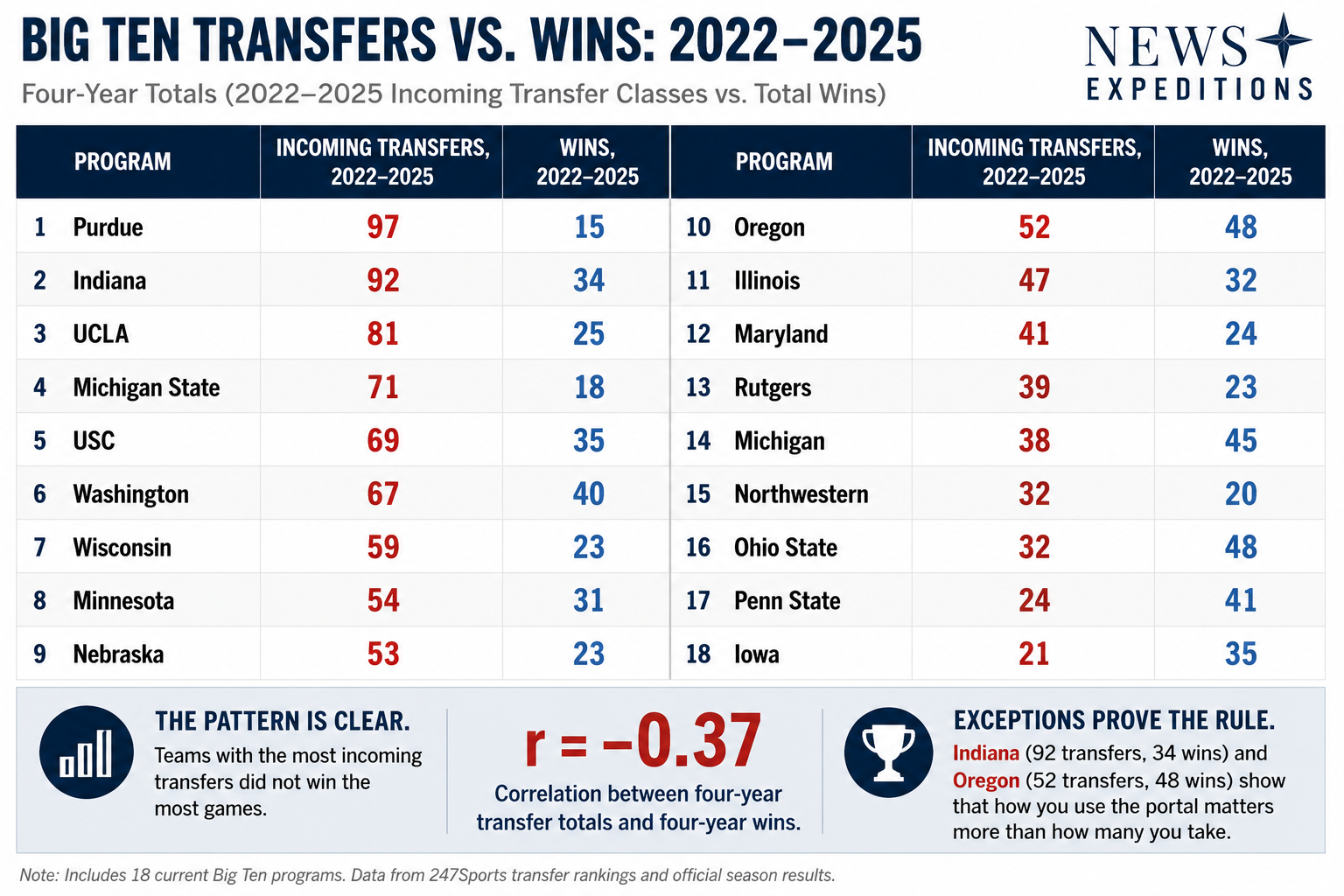
The gap at the extremes says a lot. Purdue took 97 transfers over four seasons and won 15 games. Ohio State took 32 and won 48. Penn State took just 24 and won 41. Michigan took 38 and won 45. Iowa took the fewest of anyone, 21, and still won 35.
Oregon messes with the idea that low portal usage leads to winning. The Ducks brought in 52 transfers, right in the middle of the pack, and still tied Ohio State with 48 wins. Oregon shows that a top program can use the portal actively without leaning on it as a crutch every single year.
Indiana flips the pattern the other way. The Hoosiers took 92 transfers over that stretch, second only to Purdue, and still won 34 games, capped off by a 16–0 season in 2025. Indiana won the Big Ten and the national title with a roster built largely through the portal.
These aren't just statistical quirks. They point to the exact conditions that make heavy portal use work.
Why the Correlation Is Negative
The transfer portal has a real reverse-causality problem baked into it.
It's easy to assume a big incoming class is an aggressive, strategic move that should lead to more wins. But often, the real story starts with losing.
A team struggles, players leave, and the coach gets fired. The new coach inherits open scholarships and a roster full of players who may not fit his system, so he signs 20, 30, or even 40 transfers to overhaul the roster in an emergency.
The big transfer class didn't cause the instability. The instability is what caused the big transfer class.
Purdue is the clearest case. After going 1–11 in 2024, the school fired Ryan Walters and brought in Barry Odom. Purdue then added 54 transfers for 2025, the largest single class in this entire dataset. The Boilermakers only improved to 2–10. That transfer total wasn't proof of some roster-building advantage. It was the visible sign of a program trying to claw its way back from a collapse.
UCLA followed a similar road. Its incoming numbers climbed from 13 in 2022 to 31 in 2025 and 42 in 2026. The Bruins finished 3–9 in 2025 and fired DeShaun Foster after a 0–3 start, later hiring Bob Chesney.
Michigan State brought in 71 transfers from 2022 through 2025 but only managed 18 wins. The Spartans cycled through the tail end of the Mel Tucker era, Jonathan Smith's rebuild attempt, and yet another coaching change after 2025.
For these programs, big transfer classes weren't a sign they'd figured out the portal. They were proof of how often they needed it.
Indiana: The Exception That Defines the Rule
Indiana shows that a massive transfer class really can turn into wins. But it also shows just how rare the right conditions are.
Curt Cignetti didn't just collect a pile of highly ranked players. He brought in guys who already understood his system, many of whom had direct experience playing for his staff. Indiana's transfers arrived knowing their roles, familiar with the scheme, and speaking the same football language as their new coaches.
This wasn't a typical rebuild. It was closer to transplanting an entire program.
Indiana took 31 transfers in 2024 and jumped from three wins in 2023 to 11 wins in 2024. The Hoosiers added another 23 in 2025 and went a perfect 16–0, winning both the conference and the national title.
Over those two seasons, Indiana added 54 transfers and picked up 24 more wins compared to its three-win baseline in 2023.
That's a real success story, but it shouldn't be applied too broadly. Indiana combined sharp evaluation, an established staff, experienced quarterbacks, cultural fit, and players who already knew exactly what the coaches expected.
The takeaway isn't that every struggling Big Ten team should go sign 30 transfers. It's that a well-run system can get value from volume, whereas a shaky, disorganized program simply can't.
Ohio State, Michigan, and Penn State: The Selective Model
The strongest traditional powers mostly sat at the opposite end of the spectrum.
Ohio State took 32 transfers from 2022 through 2025 and won 48 games. Michigan took 38 and won 45. Penn State took just 24 and won 41.
These programs didn't avoid the portal. They just used it with more precision.
The difference comes down to structure. High school recruiting filled most of the roster. Development and retention kept the core intact. The portal then got used to grabbing a starting quarterback, a proven defensive back, or an offensive lineman who could step in right away.
Ohio State's approach wasn't anti-portal. It was anti-redundancy. The Buckeyes didn't need 25 outside players because most of their two-deep were already stacked with blue-chip recruits.
Penn State's jump from eight transfers in 2025 to 39 in 2026 stands out as one of the most telling numbers in this whole dataset. It marks a real break from how the program used to operate, coming right after James Franklin was let go during the 2025 season and Matt Campbell took over.
Penn State's 2026 class can't be judged by wins yet. But it's fair to read it as a coaching-transition reset rather than a continuation of how Franklin ran things, as Matt Campbell swept up his decent players at Iowa State and took them with him to Happy Valley.
Iowa: Continuity With a Rising Portal Floor
Iowa took only 21 transfers over four completed seasons, and 36 across all five classes. Both numbers were the lowest in the conference, by a wide margin.
The Hawkeyes still won 35 games from 2022 through 2025, despite staying one of the least portal-dependent programs in the entire sport.
That doesn't mean Iowa's approach was perfect. Staying cautious with the portal sometimes left obvious holes unfilled, especially on offense. But it does show that continuity, development, and retention could still produce winning seasons during the most disruptive years of the portal era.
Iowa's approach is also shifting. Its intake grew from one transfer in 2022 to 15 in 2026.
That's still modest compared to the rest of the conference, but it suggests Iowa no longer treats the portal as a last resort. The Hawkeyes seem to be moving toward a hybrid approach, keeping their developmental core intact while getting more willing to bring in experienced players where internal development just hasn't cut it.
Wisconsin's Numbers Suggest a Rebuild That Never Stabilized
Wisconsin's trend is one of the more concerning ones in the league:
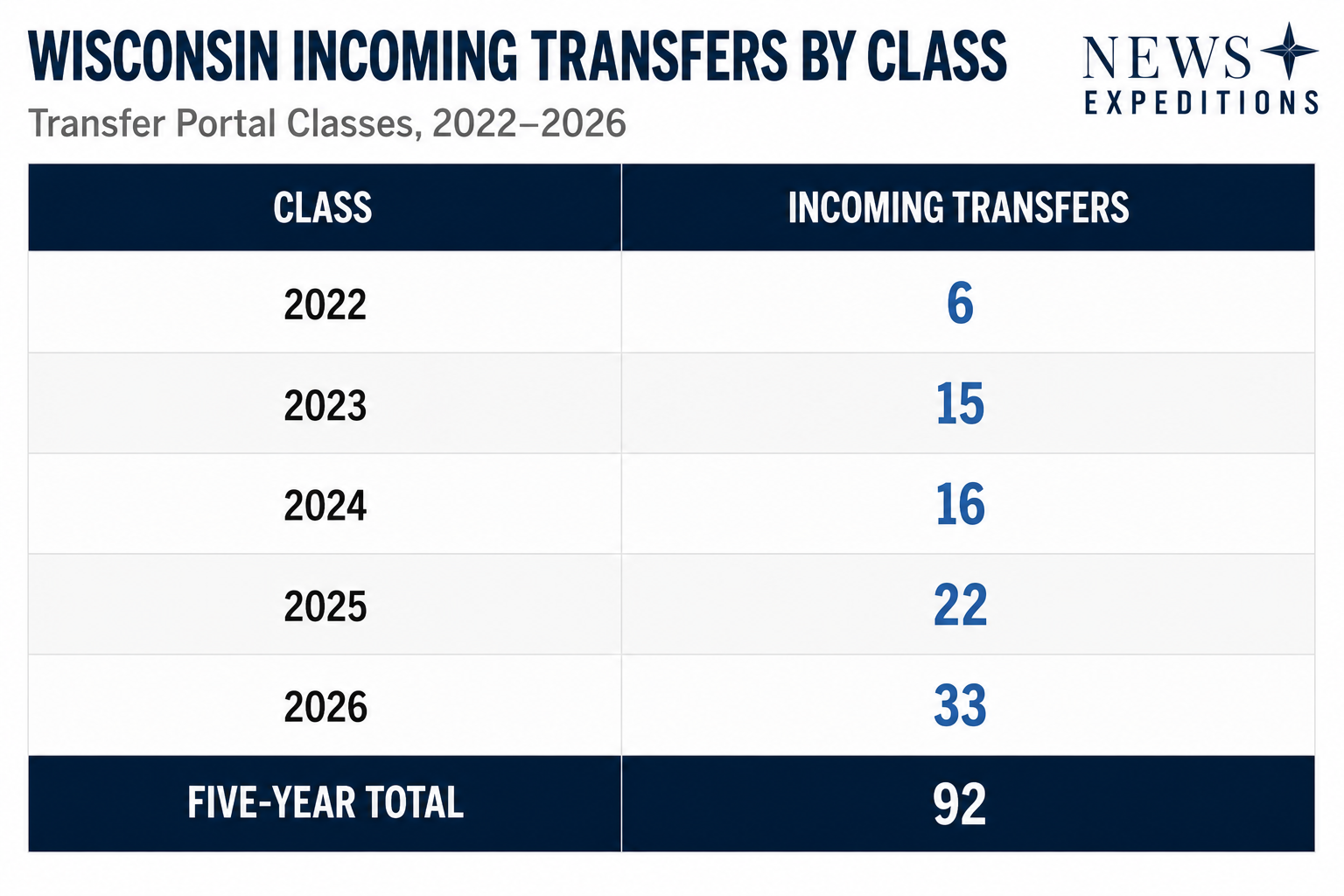
A new coaching staff often needs a big first class to reshape the roster. In a healthy rebuild, that dependence should fade as the staff's own recruits mature.
Wisconsin went in the other direction.
The Badgers took 55 transfers combined in 2025 and 2026 alone, more than the first three classes put together. Meanwhile, Wisconsin's win total slid from seven in both 2022 and 2023, down to five in 2024 and four in 2025.
That doesn't prove Luke Fickell's transfer strategy caused the slide. It suggests the staff kept looking for outside answers because the roster never stabilized.
When portal dependence grows several years into a coach's tenure, it can mean earlier evaluations were missed, recruited players didn't develop, retention fell apart, or the intended system just never took hold.
USC's Retreat from the Early Portal Model
USC went the opposite way:
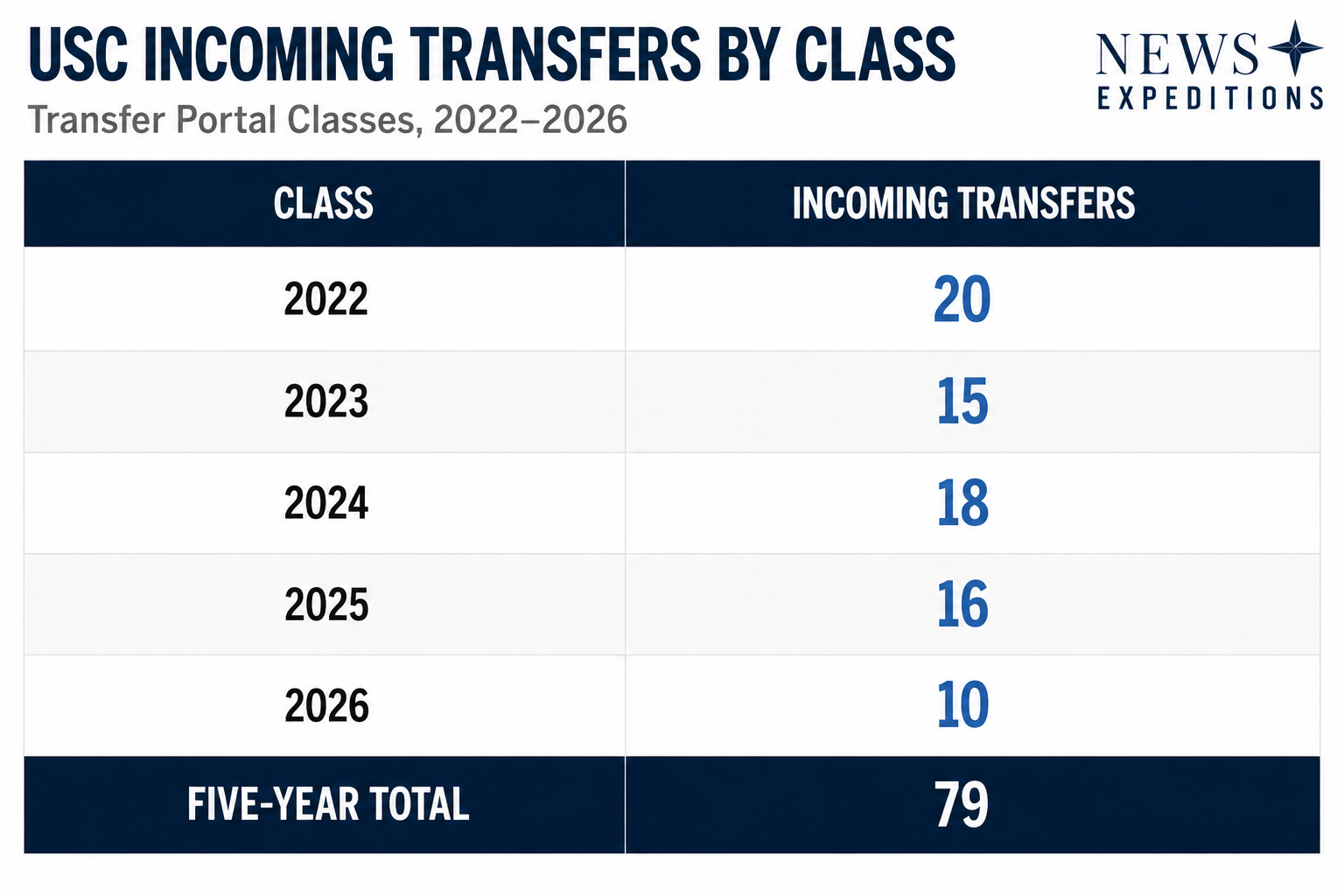
Lincoln Riley became one of the defining coaches of the early portal era, building his first USC roster around transfers who could make an immediate impact. That approach gave USC a short-term offensive boost, but it never quite added up to a complete roster.
By 2026, USC's intake had fallen to half of its 2022 level.
That trend points to a deliberate pivot toward high school recruiting, retention, and continuity. USC and Iowa are basically ending up in the same middle ground from opposite directions: Iowa leaning more on the portal over time, USC leaning less.
Four Portal Strategies Have Emerged
Five years of data sort Big Ten programs into four broad approaches.
System importers
Indiana is the textbook example. A coach uses a large class to install his system fast, often bringing in players who already understand the scheme and the culture. This can pay off quickly, but it takes exceptional evaluation and a tightly run organization to pull off.
Chronic rebuilders
Purdue, UCLA, Michigan State, and Wisconsin all racked up large or growing transfer classes without much to show for it. Portal activity here became a cycle — one big class followed by another because the roster never found stable footing.
Targeted contenders
Ohio State, Oregon, Michigan, and (until recently) Penn State used the portal to fill gaps in an already strong recruited roster. They brought in just enough outside talent to solve specific problems, without rebuilding from scratch every offseason.
Development-first programs
Iowa, Northwestern, and Rutgers leaned more heavily on high school recruiting, player development, and continuity. This cuts down on roster churn, but it can get too conservative when a position group clearly needs outside help.
What the Correlation Does and Doesn't Prove
That negative correlation shouldn't be read as proof that transfers hurt a team.
This analysis doesn't fully account for transfer quality, returning production, quarterback play, strength of schedule, injuries, recruiting rankings, coaching turnover, or the number of players a team lost to the portal. It treats every incoming transfer as equal, even though a starting quarterback and a backup long snapper obviously aren't worth the same.
It's also measuring total wins, which can be skewed by postseason play. Teams that make deep runs get more games and more chances to add to their win total.
Still, the numbers answer the main question this piece set out to ask.
Do more incoming transfers generally lead to more wins?
From 2022 through 2025, they didn't.
The raw relationship leaned negatively. Programs that brought in the most transfers generally won fewer games, while several of the league's most successful teams got there with comparatively small classes.
That lines up with the idea that the portal mostly functions as a response to roster problems, not some universal shortcut to winning.
The 2026 Class Shows Where the Conference Is Headed
The 2026 numbers can't be tied to wins yet, but they reveal some big strategic shifts.
Penn State jumped to 39 transfers after taking just 24 combined over the previous four classes. UCLA added 42 under new leadership. Wisconsin climbed to 33. Michigan State brought in 29. Purdue added another 29 on top of its massive 54-player 2025 class.
On the other end, USC dropped to 10, Oregon held steady at 13, Washington fell to 14, and Indiana pulled back to 17 after taking 31 and 23 in its two breakout seasons.
Indiana's pullback might be the most telling number of all. Once Cignetti got the program established, he didn't keep adding players at the same pace. That's what a successful portal rebuild is supposed to look like eventually: heavy initial investment followed by more selective additions.
The chronic-rebuild teams look nothing like that. Their volume doesn't drop, because each new class has to fix problems left over from the last one.
The Verdict
Five years of Big Ten transfer data push back hard against the idea that winning the portal just means signing the most players.
From 2022 through 2025, transfer volume had a correlation of –0.30 with same-season wins. Across the full four-year stretch, the correlation between total transfers and total wins was about –0.37.
More transfers didn't reliably mean more wins.
In most cases, it meant a program had more problems that needed fixing.
The portal worked best under two very different conditions. Elite programs used it selectively, picking up a small number of players who filled real needs. Indiana used it aggressively, but paired that volume with a coherent system, sharp evaluation, and an organization that was completely on the same page.
The weakest approach was repeated large-scale reconstruction without any real stability to back it up. Purdue, UCLA, Michigan State, and Wisconsin kept turning to big classes because their earlier roster-building efforts never gave them a solid foundation.
The transfer portal is genuinely valuable. But quantity is a lousy way to measure whether a program is using it well. The real questions aren't how many players a team brought in, or where its class ranked back in January.
The real questions are whether those players filled actual needs, fit the system, stuck around, and helped the team win.
Five years of evidence points to one conclusion: the best portal strategy isn't signing the most players.
It's reaching the point where you don't have to.


Comments ()